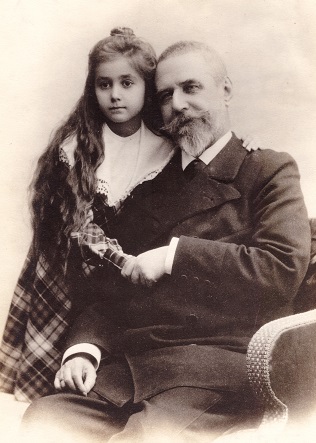
I believe my maternal grandparents, Olga and Paul Woronoff, never saw the revolution coming, and they certainly didn’t think the turmoil, violence and bloodshed would last. Coming closely on the heels of World War I, it must have been a time of such uncertainty but even so, in their minds, it was unfathomable for the country they loved so much to be on the verge of becoming unrecognisable. For if they had had any inkling their lives were going to be turned upside down and they would have to escape, never to return, I imagine they would not have left jewellery and valuables behind in a Petrograd bank.
Of course there had always been talk of changes which needed to be made. The family’s doctor, Vassiliok, often had lengthy discussions with my maternal great grandfather, Count Constantine Kleinmichel. In her memoirs, my grandmother wrote,
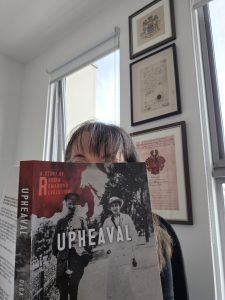
“Vassiliok had liberal ideas and, dropping his usual taciturnity, he often got into heated political arguments with my father. But while my father was excited and angry, Vassiliok became only a shade paler and his low voice trembled in wrath. Vassiliok believed in the benefit of great changes but, when the revolution came, with all its blood and ruthless cruelty, he was shaken to the depths of his soul. He did not want that.” (Upheaval 2nd edition, 2025, pg 47).
Arguably, there was one person who foretold the revolution, or at least the destruction of Russia as the aristocrats knew it. In a letter written by Rasputin, “sacred adviser” to the Imperial Family, to Tsar Nicholas II, he warns of the consequences of Russia entering World War I, “There are no words, indescribable horror. I know they all want war from you, evidently not realising that this means ruin.” (Simon Sebag Montefiore, Written in History; Letters that Changed the World, 2018, pg 106).
In her memoir, Memories of a Shipwrecked World, my grandmother’s aunt, Countess Marie Kleinmichel, tried to make sense of the chaos at the time, “Weakness and caprice; to my mind these two words completely sum up the system of government which led to the revolution.” In a letter to a friend she pointed to the similarities between the French and Russian Revolutions. Speaking of “agents, managers of sugar refineries, engineers and others,” she explained, “Most of them… are very well bred people, but their children are abominable. In every one of these families I see a little Marat of fourteen, and a Théroigne de Méricourt of thirteen, who are growing up and are very disquieting. I did not know how true my words were.” (1923, pg 222).
I think its safe to say that, unless one is a part of a revolutionary movement, or at least someone who keeps abreast of current politics, revolution will sneak up on you before it pounces. With hindsight there are always motivations and justifications, but these are often difficult to see in the present moment.
Even Vladimir Lenin, leader of the Bolshevik Revolution, stated, “It is impossible to predict the time and progress of revolution. It is governed by its own more or less mysterious laws.”

This Post Has 8 Comments
My maternal grandparents both came from Galicia. My grandmother’s home is now half way between Lviv and Ternopil thanks to the outcome of WWII and the betrayal of Polish people. My grandfather came from a well off family in Przemysl. They owned several businesses. My grandfather and his sisters were raised by governess. My grandfather said, his father observed trenches being built all around their city a few years before the start of World War I. He realized war was coming and got his family out before it came. Their city changed hands several times between the Austrian and Russian armies. There are even pictures of Nicholas II visiting when it was under Russian occupation. Those trenches still exist and there are several videos on Youtube about their history. My grandfather arrived in Canada as a 13 year old boy, the eldest of 4 children with only a few trunks of clothes, a handful of pieces of silver from their family restaurant and a few Polish books, one being a book of recipes used in their family businesses, in May, 1914. I have the ticket from their ship which sailed out of Hamburg.
Denise, thank you for reading my blog! It sounds like your maternal great grandfather was wise and understood what might happen. I guess if you see trenches being built, it is a good indication that some sort of conflict might follow. You are so lucky to have the ticket from their ship – its a piece of history.
Thank you. From that ticket, I was able to find a picture online of the exact ship, the Hannover. I also have the immigration form which was given to him when the ship landed. I was surprised at how small the Hannover was. Grandma came to Canada on a much larger ship, the Kaiserin Auguste Victoria, in 1922. Those trenches around their city are nothing like the trenches we see in current pictures from the frontline. Their city was really turned in a fortress.
I really enjoy reading about your family history and your journey discovering it on your blog,
I wonder if that was the same Hannover (Hanover) which took my grandparents from Russia to Constantinople in 1920?
From my grandfather’s experience people were aware of the coming war. He was only 13. Maybe most just didn’t realize what the extent of the coming catastrophe would be, so did not prepare soon enough if they could.
That would definitely have been the case for some people. Although I have no proof, I think my grandmother was thinking only of my grandfather’s safety as he fought in WWI and probably didn’t realise the revolution was around the corner. Of course I could be wrong!
Just my opinion; your family, like the rest of the world, was not alone in experiencing the world-wide political, social and revolutionary changes that were brought about at the close of WWI. The world had been transformed, it marked the end of the “old world” and the beginning of the political instability of the modern 20th-century social order going into the 21st-century. Your grandparents are to be commended for their courage in the face of extreme difficulty.
Thank you Jim. They definitely weren’t alone!